

What good can come from experiencing sorrow in your life? Sorrow can lead a person to a deeper trust and reliance upon our Gentle Savior! Likewise, sorrow can become a source of frustration, anxiety, and bitterness in our life. The choice is ours! Bible passages are from the Berean Standard Bible. Quotes are from Oswald Chamber’s Devotional: Upmost for His Highest. Incorporating quotes for the purpose of spiritual discussion and discernment, not for profit or personal benefit.
“Fires” of Sorrow
Chambers uses the analogy of fire to describe sorrow. What a fitting description! Fire spreads, grows as it consumes dry fuels. Dry fuels become heat and smoke as a fire rages. Sorrow comes into our lives during different seasons for various reasons. Sometimes it’s our own folly and in other times it’s due to someone else’s. What matters is how that we respond and invite God into our situations! Sorrow can consume the dross of our lives and refine us! God works through difficulties and sorrow to make us more like Him!
As a saint of God, my attitude toward sorrow and difficulty should not be to ask that they be prevented, but to ask that God protect me so that I may remain what He created me to be, in spite of all my fires of sorrow.
Chambers, June 25

Jesus’ Response to Sorrow
How does Jesus respond to sorrow? Let’s consider three examples. The first example is when Jesus arrives at Bethany and encounters Mary, Martha, and others in John chapter 11. The second example is Luke 19:41-44 as Jesus weeps over Jerusalem’s destruction. The third example appear as Jesus faces His own sorrow prior to His betrayal and death. What other examples of sorrow can you locate in God’s Word?
When Jesus’ friend Lazarus dies from an illness: Jesus wept (John 11:33). Why? Jesus responds to the sorrow and grief that He sees in His friends’ lives. Jesus knows that He is going to revive Lazarus. Jesus is moved by His own and other’s emotions. Obviously, it’s appropriate to respond to loss and death with grief. Allow yourself to grieve what is lost! Jesus appears in the Gospels as being a man of deep compassion and understanding. He knows your sorrows as well and walks with His children during moments of sorrow! Tell Him about what you have lost and are dealing with!
When Jesus arrives in Jerusalem for the Passion Week, He responds with sorrow to the coming destruction of Jerusalem and their lack of repentance. Jesus desires that hearts change and accept God’s Truths. Do you feel sorrow over those who aren’t trusting and depending on God’s grace? Part of being like Christ is reflecting His love and desire for others to follow Him in truth and grace! Luke 19:41-44 reveals Jesus’ response to the Pharisees who told Jesus to rebuke His disciples for rejoicing and praising Him as He enters Jerusalem–Palm Sunday. Interesting how the “religious” leaders/teachers get disturbed by praise and worship!
The third example appears as Jesus explains His coming death in John chapter twelve. Some Greeks were present to worship at the feast and request the Disciples to see Jesus. Jesus explains His purpose:
John 12:23-28
23But Jesus replied, “The hour has come for the Son of Man to be glorified. 24Truly, truly, I tell you, unless a kernel of wheat falls to the ground and dies, it remains only a seed; but if it dies, it bears much fruit. 25Whoever loves his life will lose it, but whoever hates his life in this world will keep it for eternal life. 26If anyone serves Me, he must follow Me; and where I am, My servant will be as well. If anyone serves Me, the Father will honor him.
27Now My soul is troubled, and what shall I say? ‘Father, save Me from this hour’? No, it is for this purpose that I have come to this hour. 28Father, glorify Your name!”
Then a voice came from heaven: “I have glorified it, and I will glorify it again.”
Our Lord received Himself, accepting His position and realizing His purpose, in the midst of the fire of sorrow. He was saved not from the hour, but out of the hour.
Chambers, June 25
Jesus accepts His mission, purpose, and role in God’s Plan of Salvation. What is your role in life? Live for yourself seeking pleasure, accumulate wealth, make a name for yourself? What if God has something far better? For additional information on the situations wherein Jesus wept:
https://www.gotquestions.org/Jesus-wept.html
Previous article concerning trials:
God’s Purpose in Your Struggles: 6 Essential Truths

God’s Best for Us
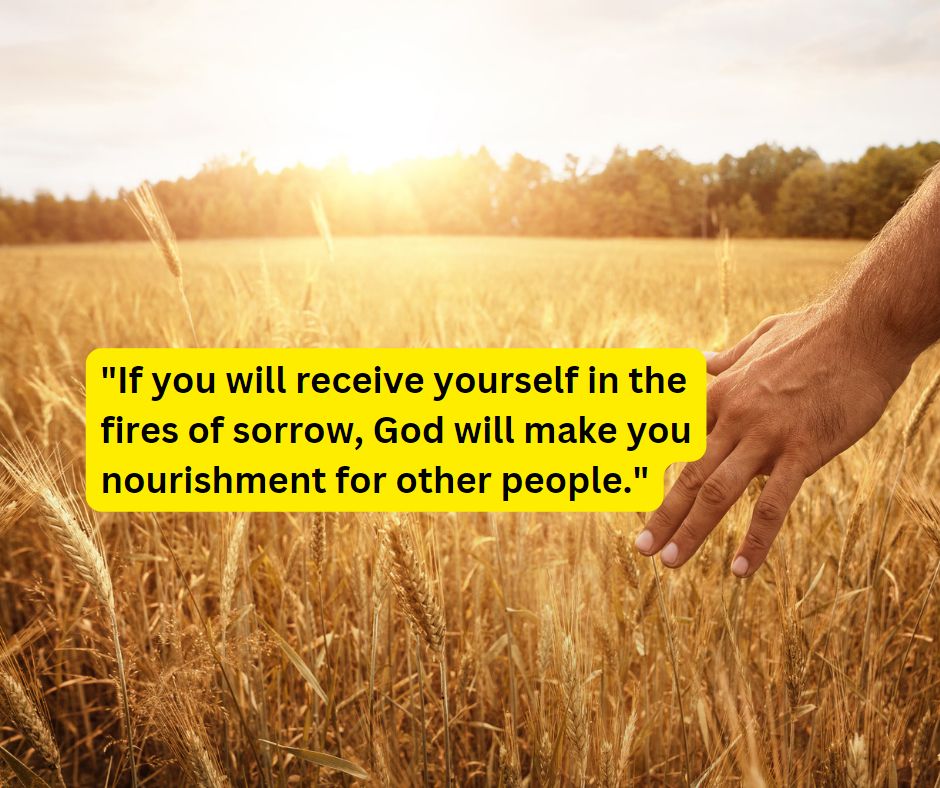
Chambers explains that we can recognize who has been through “the fires of sorrows and received Himself”. Such a person gives time and “ear” to others! Experiencing sorrow has a purpose: to refine and focus us on God’s purposes turning away from seeking comfort or ease. Sorrow strips away or pride, vanity, and self-reliance if we turn to God instead of trying to “improve ourselves.”
I want to be clear: I am not speaking against working to improve yourself when self improvement or changes are necessary! We need to accept responsibility for our shortcomings, mistakes, and failure(s) and seek to align ourselves with God. The issue is the constant striving to improve self through our own methods of self-improvement instead of trusting God.
The issue with self-improvement comes about when we realize that while we can modify certain attitudes and behaviors but not remove our sinful desires. We are powerless to redeem ourselves or anyone else! There is a choice between self-effort and receiving grace. Self-effort leads to religious and self-righteousness instead of dependence and trust in God’s grace. It’s easy to recognize this worldview in those who are overly judgmental, harsh, and condemning of others.
You can always recognize who has been through the fires of sorrow and received himself, and you know that you can go to him in your moment of trouble and find that he has plenty of time for you.
But if a person has not been through the fires of sorrow, he is apt to be contemptuous, having no respect or time for you, only turning you away.
Chambers, June 25
Finding yourself in sorrow brings humility and depth into your walk with Christ. Why is it that people become prideful and boastful? Our hearts tend to be selfish and self-interested. God will change this as we walk and depend on Him!
As you experience sorrow in life is your heart open to receive God’s grace and guidance? God will lead you through these difficult seasons! Psalm 23 and reflecting on the Gospels are powerful tools to assist you in focusing on Christ during the hard moments. Accepting the loss, grieving with hope, and trusting in God to redeem all things enables us to set an example for others. James reminds us:
James 1:2-4
2Consider it pure joy, my brothers, when you encounter trials of many kinds, 3because you know that the testing of your faith develops perseverance. 4Allow perseverance to finish its work, so that you may be mature and complete, not lacking anything.
Greek word and passage study insights
Source: Enduring Word Commentary
First, “Patience is the ancient Greek word hupomone. This word does not describe a passive waiting but an active endurance. The ancient Greek word hupomone comes from hupo (under) and meno (to stay, abide, remain). At its root, it means to remain under. It has the picture of someone under a heavy load and choosing to stay there instead of trying to escape. The philosopher Philo called hupomone “the queen of virtues.” (Cited in Hiebert) The Greek commentator Oesterley said this word patience described “the frame of mind which endures.””
James encourages us to endure the trials that are certain to come to us in our journeys of faith.
Second, we are to count this as joy: faith guides us toward joy and away from discouragement!
“Produces patience: Trials don’t produce faith, but when trials are received with faith, it produces patience. Yet patience is not inevitably produced in times of trial. If difficulties are received in unbelief and grumbling, trials can produce bitterness and discouragement. This is why James exhorted us to count it all joy. Counting it all joy is faith’s response to a time of trial.”
Third, maturity in this passage is a process! Bible ref commentary explains:
“In fact, this verse [4] says that perfection—complete maturity—is found only in perfect faith in God. More specifically, James uses the concept of endurance—steadfastness or perseverance—to describe the ability to trust God more and more. As a runner gains endurance by suffering through another mile, Christians also gain the ability to trust God through trials. Each experience grants us a deeper, stronger level of trust in Him. In all areas of life, growth only comes through overcoming difficulty. Spirituality is no different.”
Source: https://www.bibleref.com/James/1/James-1-4.html

 Words of Grace & Hope
This was deeply encouraging. I appreciate how you describe sorrow as a refining fire—one that God uses to deepen our trust and shape us in His image. Your spiritual insight offers real hope in the midst of pain. Thank you for guiding us toward growth in the crucible of sorrow.
LikeLiked by 1 person
God is our True Guide thanks for your comment!
LikeLike
Sorrow reshapes us, and this post gently captures that truth. It reassures that painful seasons aren’t where we lose ourselves, but where we sometimes uncover parts of God’s heart in us.
LikeLike
sorrow that leads us to experience the presence of God in our deepest being. . .well said thanks
LikeLike