

Healing Through Forgiveness
Featured Image: Light Shines through the storm clouds.
Link to previous posts in this series:
https://wordsofencouragementinchrist.com/category/journey-of-healing/trauma/
Disclaimer: This article seeks to encourage those struggling with trauma. It is for informational, educational purposes only and does not constitute professional advice. It is not intended to diagnose, treat, or cure any mental health condition. If you are in an abusive relationship or experiencing severe emotional distress, seek help from a qualified mental health professional, contact law enforcement or contact a domestic violence hotline. Your physical, spiritual, and emotional well-being is your top priority.
*Resources and information are not to be considered complete and does not cover all issues related to mental and physical health. In addition, any information given does not replace consultation with your doctor or other mental health providers and/or specialists.
This post includes links to other writers, and life coaches relevant to this topic. Readers, understand the limitations of self-help and life coaching: trauma recovery requires professional mental health treatment.
I write about trauma with the intention of sharing insights and resources that have helped me in my healing journey. God walks with us in our seasons of loss, disappointment, and difficulties. Recognizing trauma and choosing to forgive others are pathways to a healthier journey!

Recognizing trauma’s presence
The human mind has a tendency to suppress difficult experiences and emotions. While this may seem the easiest or natural path forward, it leads to more grief and suffering in the future. For example, when a person experiences trauma from being in a toxic job environment, the issues continue after leaving the specific environment. In a similar manner, those who lose a loved one report that certain sights, sounds, and scents bring back both positive and negative emotions. Often the way that we react to other people and situations in our lives comes from our previous experiences (negative, neutral, or positive).
What does this mean? An immediate feeling or reaction reveals that our minds work on both a conscious and subconscious basis. We may feel or react to various events or “triggers” without consciously thinking. It’s a reaction that proceeds conscious recognition. Below are some common triggers.
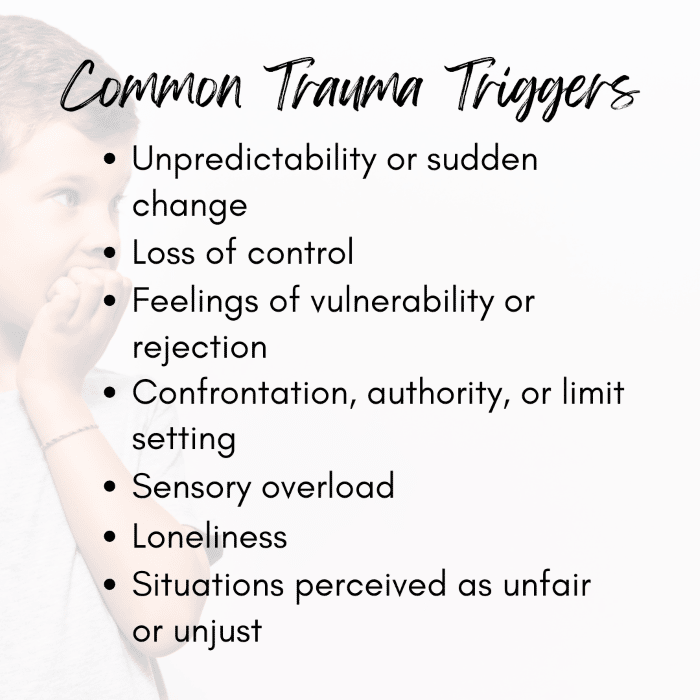
Source: Graphic is property of Youth Dynamics.
Mark DeJesus Video Resource
The reality is that how we perceive an action or comment is more important than the actual event. My past experiences of being disrespected and being/feeling powerless to address it provokes a reaction. Is it wise to respond when triggered or angry? This how power struggles and intense personal conflicts emerge.
A power struggle involves a cycle of triggers, response, retaliation, etc. It’s wise to avoid this cycle as it often makes the situation more hostile and emotionally damaging. So how does one navigate this issue?

Core Wounds
Discerning the core wounds of our life helps us to better understand patterns of thinking and acting that hinder healing and growth.
Moving Forward toward healing: Identifying Core Wounds
As I’ve written in past posts, the key to moving forward is healing. Healing brings us to the place of recognizing and addressing our core wounds. The term “core wounds” in this context refers to the areas of our spiritual and emotional hurts that impact our mindset.
Dr. Lissa Rankin (MD) defines a core wound:
Core wounds tend to be things like a sense of not being enough, of being unlovable to a parent, of feeling stupid, dirty, unwanted, or ugly.
No matter what your core wound may be, you can guarantee that your wound influences who you are and how you behave. You may heal your wound, yet how it affects you may live on.
https://www.psychologytoday.com/us/blog/owning-pink/201008/whats-your-core-wound
Dr. Rankin writes about how she struggled to find a place so she created a community.
Summary: Core Wounds
Definition:
Core wounds are deep-seated emotional injuries that originate in early childhood and can have a lasting impact on a person’s life. They are often caused by experiences of neglect, abuse, trauma, or loss.
Types of Core Wounds:
- Abandonment: Feeling unloved, rejected, or left behind.
- Rejection: Being criticized, judged, or feeling unworthy.
- Humiliation: Experiencing shame, guilt, or feeling inferior.
- Betrayal: Feeling deceived, lied to, or manipulated.
- Inability: Feeling incompetent, inadequate, or unable to cope.
Impact of Core Wounds:
Core wounds can lead to a variety of problems, including: Low self-esteem, Difficulty with relationships, Anxiety and depression, Substance abuse, and Chronic health conditions.
Source: Generative A.I. Google

Costs of Not Healing Trauma
Others who have unhealthy emotional responses, weak boundaries, and overall negative or avoidant tendencies haven’t healed past and current hurts. Often we’re not aware of what the people around us have navigated through or are currently experiencing until they tell us. Active listening and setting appropriate boundaries help us to navigate our relationships. Forgiveness, grace, and kindness are the foundations for growing mindset!
The Health Benefits of Forgiveness
Mayo Clinic explains:
Forgiveness can lead to:
- Healthier relationships.
- Improved mental health.
- Less anxiety, stress and hostility.
- Fewer symptoms of depression.
- Lower blood pressure.
- A stronger immune system.
- Improved heart health.
- Improved self-esteem.
Source: https://www.mayoclinic.org/healthy-lifestyle/adult-health/in-depth/forgiveness/art-20047692
Forgiveness is the pathway for healing- a choice to be like Christ!
“Forgiveness is often (or perhaps usually) granted before it’s felt inside. When you forgive somebody, you’re not saying, “All my anger is gone.”
What you’re saying when you forgive is “I’m now going to treat you the way God treated me. I remember your sins no more.”
― Timothy J. Keller, Forgive: Why Should I and How Can I?

How God Heals Us: Forgiveness
Jesus speaks a parable and teaches Simon the Pharisee about forgiveness and love. Ask yourself as you read this passage from Luke: who is made right with God? Is it the self-righteous religious expert, or the sinful woman who responds to Jesus’ grace?
Luke 7:40-50 Berean Standard Bible
40But Jesus answered him, “Simon, I have something to tell you.”
41“Two men were debtors to a certain moneylender. One owed him five hundred denarii, and the other fifty. 42When they were unable to repay him, he forgave both of them. Which one, then, will love him more?”
43“I suppose the one who was forgiven more,” Simon replied.
“You have judged correctly,” Jesus said.
44And turning toward the woman, He said to Simon, “Do you see this woman? When I entered your house, you did not give Me water for My feet, but she wet My feet with her tears and wiped them with her hair. 45You did not greet Me with a kiss, but she has not stopped kissing My feet since I arrived. 46You did not anoint My head with oil, but she has anointed My feet with perfume. 47Therefore I tell you, her many sins have been forgiven, for she has loved much. But he who has been forgiven little loves little.”48Then Jesus said to her, “Your sins are forgiven.”
49But those at the table began to say to themselves, “Who is this who even forgives sins?”
50And Jesus told the woman, “Your faith has saved you; go in peace.”
Verse 47 teaches us how that love and forgiveness are linked together. When we have experienced God’s forgiveness in our lives, we respond with love. A response of love doesn’t mean that we neglect seeking justice or allow others to abuse us. It means that we choose to follow and depend on Christ instead of seeking revenge for ourselves!
Pastor Tim Keller writes:
“The experience of divine forgiveness brings profound healing. It is grounded in a faith-sight of Jesus’s costly sacrifice for our forgiveness. That reminds us that we are sinners in need of mercy like everyone else, yet it also fills the cup of our hearts with his love and affirmation. This makes it possible for us to forgive the perpetrator and then go speak to him or her, seeking justice and reconciliation if possible. Now, however, we do not do it for our sake—but for justice’s sake, for God’s sake, for the perpetrator’s sake, and for future victims’ sake. The motivation is radically changed.”
Source: Timothy J. Keller, Forgive: Why Should I and How Can I?

Forgiveness frees those in bondage to strife and discord. Freed to love and live in peace with joyful contentment.
Forgiveness prevents resentment
Cleveland Health Clinic explains the root causes and issues that come with resentment.
https://health.clevelandclinic.org/what-is-resentment
Forgiveness is the path that prevents resentment from taking root. Resentment and bitterness are poisons that infect our souls and then spread through out our relationships. Resentment, bitterness, unforgiveness lead to rage, malice, and hatred. One bitter person negatively impacts surrounding people.
Resentment, bitterness, and malice are a root cause of the increasing violence in our society. These toxins destroy families, traumatize/harm children, and increase the incidents of physical, verbal, emotional, and spiritual abuse in our nation.
Resources on Forgiveness: Recommended Books
Post with video discussions:
He will restore and heal the broken! Our hope is not that all is well, but is that He will make all things anew in His perfect time.

 Words of Grace & Hope