

The Trigger of Disrespect
(CPTSD) stands for Complex Post Traumatic Disorder. Links included to provide supplemental information to explain various impacts of this deep emotional wounding.
Author Life Update:
Currently training to work with clients on life skills coaching through the Personal Development School Certified Attachment Coaching Program. I write about my experience(s) with the intention to help others who may struggle with similar sorrows.
Anger, Resentment from feeling disrespected
One aspect that causes me to feel immense anger and resentment is the feeling of being disrespected. Why is this such a powerful trigger? In my past, I was frequently disrespected, minimized, and punished when I refused to comply with an authority figure’s demands. This began in my childhood and it has lead to serious conflicts throughout my adult life. I experienced bullying and harassment as a child and teen with severe facial acne and my non-athletic physical appearance.
Shame is one of the root causes of this powerful inner anger. Feeling powerless, rejected, and overlooked triggers an intense anger response. This anger creates relational difficulties. Consider the term “hypersensitive” and “over-vigilance” in this context. Because of past traumas and negative associations (emotional to events), the mind maintains a heightened alert and sensitivity to the environment. Simply explained, you’re on high alert for signs of disrespect and aggression in order to protect self.
Tim Fletcher’s Excellent Explanation
Article:
Tim explains:
“Feeling disrespected is a huge part of shame for those with complex trauma. It often comes from tough environments where criticism and neglect are common. This can make us see disrespect where it doesn’t exist and react strongly, hurting our relationships. Shame can push us to hide our true selves behind a perfect image and create deep insecurities.”
Shame leads to inauthentic life and self-image. He explains how that trauma impacts the mind and perception of reality.
“Trauma doesn’t just make you sensitive – it alters your perception. Consider these common distortions:
1. The Mind Reader: “They didn’t reply to my text because they don’t value me” (when in reality, they’re just busy)
2. The Catastrophizer: “My boss pointed out an error – I’m going to be fired”
3. The Time Traveler: “This feels exactly like when my father would…”
These aren’t conscious choices – they’re automatic trauma responses firing faster than rational thought. “
Core Wounds
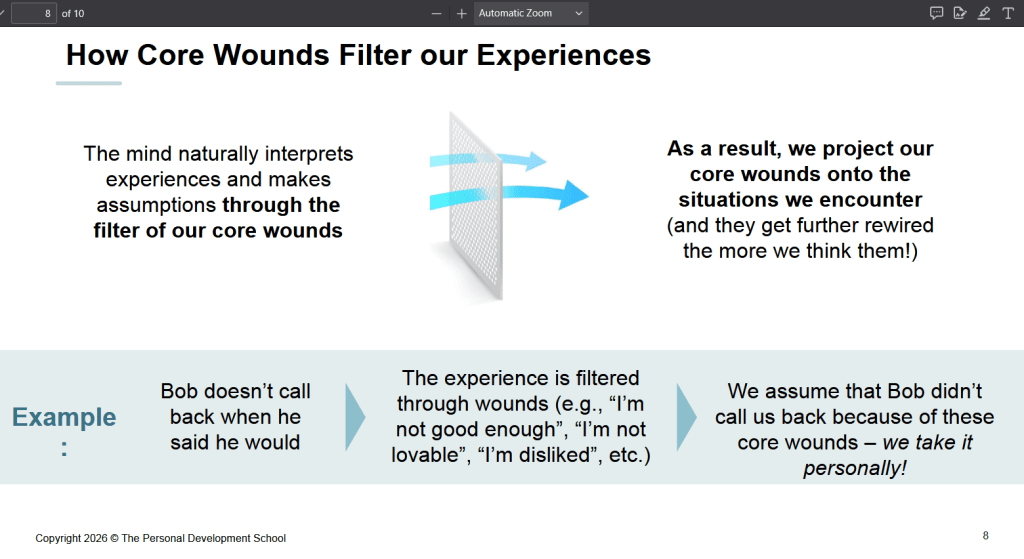
We all have a mental schema or “filter” through which we process our environment and interactions with others. Our core wounds causes us to filter experiences through these wounds and project the wounds onto the situations of daily life.
What are core wounds?
Brent Peak, LPC North Valley Therapy Phoenix, Arizona
A core wound isn’t just a painful memory. It’s a message you internalized about yourself and the world when your emotional needs weren’t met early in life. . .You develop an internal belief system that tells you who you are and how safe (or unsafe) it is to be you.
These beliefs don’t live in your rational mind. They live in your nervous system, in your body, in the patterns you can’t talk yourself out of.
Source: https://northvalleytherapy.org/why-you-still-feel-broken-understanding-your-core-wounds/
Core wounds are subconscious meaning that you may not be fully aware of them consciously. However, you can discover your core wounds by considering the whys behind personal reactions, triggers, or responses to different situations you encounter in life. Thais Gibson has excellent resources available on Youtube to help you in this process.
Thais Gibson Professional Development School created this image to explain the process:
How Core Wounds and Experiences Interact
The Costs
When perceiving disrespect, a person dealing with CPTSD will commonly react in one of three ways: people pleasing (fawning), fight or flight, and/or intense anger. These adaptations learned in childhood to survive don’t work effectively in everyday life. Being constantly triggered, living on edge, feeling unsafe/anxious leads to emotional burnout.
Power struggles develop and resentment grows in professional, personal, and family relationships. Patterns of low mood, persistent conflict, feeling unworthy, and physical and emotional burn out leads to anxiety, depression, and emotional exhaustion.

Thais Gibson: Fearful Avoidant and CPTSD
Thais gives an overview of Complex Trauma (CPTSD) and fearful avoidant attachment style. She explains the similarities, differences, and impacts on relationships. She mentions the subconscious aspects of our core wounds and how we can improve through vulnerability and boundary setting.
Why healing seems so difficult
Quoted Article
Annie Tanasugarn, PhD
Source: “The Reasons Some People Won’t Heal Their Trauma
Understanding the hidden dynamics that can keep you from growth.”
Article published on Medium in Invisible Illness
https://medium.com/invisible-illness/the-reasons-some-people-wont-heal-their-trauma-fa360d69ead0
Quote 1
“The truth is, healing demands vulnerability. But vulnerability is something we were never taught to embrace; we were taught to avoid it at all costs. The idea of examining those wounds can be terrifying, not because it’s inherently dangerous, but because doing so would require confronting the abandonment, the abuse, the neglect, or the dysfunction we have experienced. And for someone who’s built their life around avoiding pain, confronting it can feel like the beginning of the end.”
Have you been betrayed by others after opening up or starting to trust them? This is a deep core wound that remains long after the original betrayal. The tragedy is that betrayal trauma causes a person to be more vulnerable to exploitation and abuse when this pattern seems familiar. Core wounds are the areas of our lives wherein we are deeply wounded and it’s often the core wounds that reside in our subconscious minds that drive our patterns of behavior.
Our souls crave vulnerability and connection. Yet this wound creates a connection between vulnerability, betrayal, and hurt that forms a strong association. It becomes easier to avoid than to engage. We become so comfortable with the pain that we fear letting go lest we “lose ourselves.” The false self that keeps us safe needs to pass away for the authentic self to be visible and accepted by others.

Quote 2
“Healing requires us to face the pain, to unwrap it, to try it on, and to examine it in the mirror. It requires us to sit with the discomfort, and to begin noticing the patterns. Healing also requires us accepting that the only thing standing between us and a healthy relationship, is ourselves.”
Our patterns of behaviors and thoughts come from our mind’s attempt to meet needs. We all have needs and desires as human beings. It’s our methods and inefficient ways of meeting these needs that keeps us in patterns of denial, immaturity, and brokenness. Thais Gibson refers to needs.

Why people reject healing
This topic is difficult to consider! Yet, it’s true and explains our impulse to resist healing and growth.
“A lot of the time, when we try to “show someone the light” so they can begin taking the steps to heal, what is often being missed is how deep their relationship with their pain runs. For many, it’s not about what they’ve survived; it is how they’ve learned to adapt. Their trauma has become so enmeshed with their sense of self that to break free can trigger an existential threat. Letting go of their past means letting go of the life they’ve built for themselves, and the identity they have created based on this survival.” Annie Tanasugarn, PhD
The false sense of self is comforting. The thought and experiencing of losing one’s self leads to a deep fear and grief (existential dread). This is why that it seems so hard to let go! Why is difficult to let go?

Trauma and Sense of Control: Fear of the Unknown
“Holding on to pain can feel strangely empowering. . .To heal, we have to surrender to the pain, to the problems and to the trauma. We have to give up control and to feel the uncertainty of not knowing what comes next. Healing also means making a cognizant choice in being vulnerable, in allowing others to be let in, in being emotionally open (scared, raw, and unsure), and in taking the chance that vulnerability may cause you more pain.”
“Pain can feel comfortable, familiar, and like home for many of us. Letting go of the trauma and releasing it can strangely feel like betrayal.” Annie Tanasugarn, PhD
The path forward involves surrender and choosing to be vulnerable to others. Vulnerable with individuals who demonstrate strong morals and are safe individuals! Discernment is vital. Giving up control is the most difficult part for me. The fear of being rejected, ignored, minimized, and cast away as defective are valid fears. Our past experiences often shape our perceptions of others.

Tim Fletcher gives insight on how to move forward: emphasis mine
The Path Forward
“Healing from complex trauma isn’t about becoming “less sensitive” – it’s about developing the discernment to know when your reactions are protecting you from ghosts of the past rather than present reality. Each time you pause before reacting, question your assumptions, or offer yourself compassion, you’re not just managing symptoms – you’re rewriting your nervous system’s survival blueprint.
Remember: What feels like an overreaction to others is often a perfectly reasonable response to what you’ve survived. The goal isn’t to stop caring, but to start responding from choice rather than trauma.
Your sensitivity isn’t a flaw – it’s a survival skill that’s outgrown its usefulness. With patience and practice, you can transform it into your greatest strength: the ability to feel deeply while remaining grounded in the present. “
Tim Fletcher, “Why Disrespect Feels so Painful”
 Words of Grace & Hope