
A Path Forward in Your Healing Journey
Featured Image: Photo by Guillaume Henrotte on Unsplash
This post explains the challenges of practicing acceptance in a journey of emotional and spiritual healing and provides graphics and links to resources. *This author is not a licensed mental health professional. This post seeks to offer perspectives and resources to assist readers in practicing discernment in spiritual and emotional healing.
Definition of Radical Acceptance:
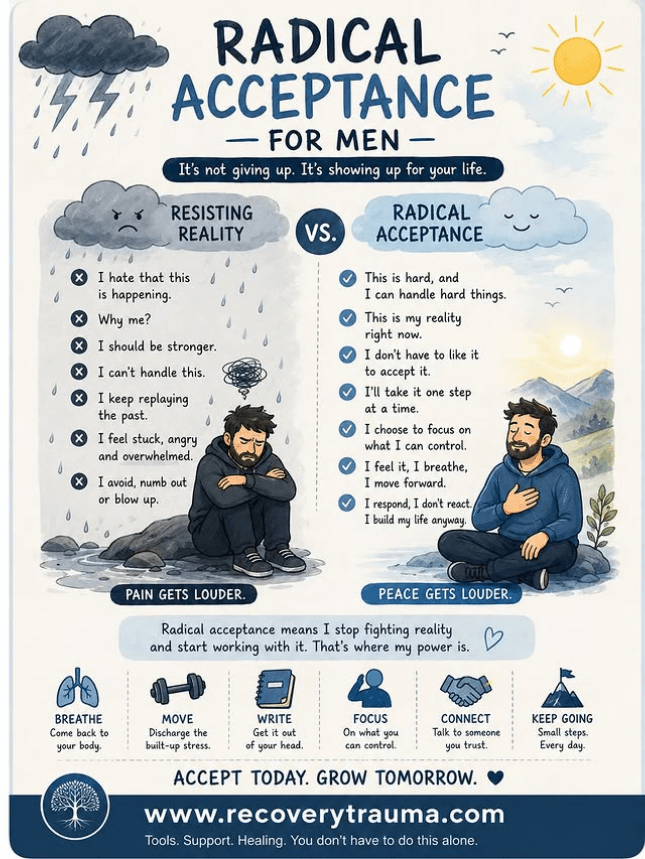
So what’s Radical Acceptance? What do I mean by the word ‘radical’? Radical means complete and total.
It’s when you accept something from the depths of your soul, in your mind, in your heart, and even with your body. It’s total and complete.
When you’ve radically accepted something, you’re not fighting it. It’s when you stop fighting reality. That’s what radical acceptance is.
Source https://neilbtherapy.com/wp-content/uploads/2024/07/radical-acceptance-M-Linehan.pdf

Glacier Point, Yosemite Valley, United States Photo by Elijah Hiett on Unsplash
Why is it difficult to daily practice radical acceptance?
Very Well article on radical acceptance explains: emphasis mine
“Some people have a hard time accepting situations because they feel as though acceptance is the same thing as being in agreement with what happened or saying that it is OK. In other cases, people don’t want to acknowledge the pain that would come with acceptance.
Whatever your reasons for a lack of acceptance, know that these feelings are normal, and many other people have felt the exact same way. That does not mean that it is impossible for you to feel differently or eventually get to a place of acceptance. It will just require practice and dedication.”
Source: https://www.verywellmind.com/what-is-radical-acceptance-5120614#toc-why-practicing-it-can-be-hard
Practice and dedication are necessary. I’m including some worksheet links in this article.
When radical acceptance isn’t appropriate:
The Very Well article explains circumstances in which radical acceptance isn’t appropriate. Evaluate your present situation wisely:
“Most of these involve situations where it is more prudent to try and make a change in the situation rather than accept things the way that they are.
- If you are in an abusive relationship or someone is treating you poorly or with disrespect,
- If you are being harassed, taken advantage of, or not treated fairly at work,
- If you are experiencing burnout or a lack of motivation with your current situation,
- When you are intentionally not taking action out of fear, and
- When acceptance becomes an obstacle to actually improving your situation or standing up for yourself”
Physical, emotional, and spiritual safety are essential to well being. If you’re in immediate danger contact the domestic violence support network at 1.800.799.7233 as well as your local emergency services/law enforcement. For mental health emergencies contact 1-800-950-6264.
Many employers have third party resources available through an Employee Assistance Program. If you’re being disrespected, harassed, or victimized in the workplace keep a log of specific events with a date and time as well as the names of any witnesses. It’s critical that you report issues to the appropriate management so that the appropriate measures can be taken to protect yourself and others. If someone is mistreating you then it’s likely a pattern of behaviors/interactions that are impacting others.
If abuse and disrespect are happening in the workplace or in personal relationships and it’s not appropriately managed, then it will likely escalate in portion to the lack of accountability and environment in which these behaviors are tolerated within an organization or family unit.

Photo by Vantage Point Photographers on Unsplash
Personal Reflection:
In my experience, toxic workplace environments and relationships rarely improve. If appropriately reporting and establishing boundaries don’t solve the root issues or permit a safe environment in which to thrive, then it’s your responsibility to evaluate the costs of remaining.
Previously, I remained in less than ideal and toxic environments stubbornly hoping that things would improve or that I could “fix” people or situation. This decision increased my emotional suffering leading to long term complications to my emotional, physical, and spiritual health. Tolerating and staying in toxic environments hinder personal and career growth.

Shenandoah National Park, Virginia, USA Photo by Ivan Zhirnov on Unsplash
When it’s best to practice radical acceptance:
Very Well article lists several common situations:
- If you are going through the end of a relationship
- If you are experiencing an unexpected change (such as job loss)
- If a loved one has died
- If you’ve experienced a traumatic event (such as neglect or abuse as a child)
- If you refuse to accept what happened and are avoiding emotions
- If you feel stuck or unable to move on from a negative event
- If you have tried other ways to deal with your pain and nothing has worked
My Experience with Radically Accepting a Job Loss and Navigating Health Issue(s)
Once an employer informed me that I would no longer being remaining in my position for the upcoming year. Several months later while undergoing a routine, required health screening, I received bad health news. The hardest part for me was accepting the job loss, coming loss of health care insurance, learning to live with a chronic health condition, and trying to move forward in life. Those losses required time to process and grieve. Changes had to be made, life changed.
The Practical Value of Acceptance: My Experience(s)
Acceptance released me from the prison of intense anger, self-doubt, and regret. Moving forward required major life style changes: learning how to restore and maintain my health as well as increasing my career opportunities. At first, I was angry, felt betrayed and explored every option to fight my employment situation. When I had used every option with no result, then I had to figure out a new way forward.
As a result of losing this one job, I learned to financially prepare and wisely invest in additional training so that I would never again be dependent on any one job or opportunity. I diligently researched the trades then invested in part-time trade school training. Months later, applied for and received a scholarship that enabled me to attend full time vocational trade school and set up a summer internship to get practical experience and valuable references.
The health condition taught me to never take my health for granted and to make major changes in dealing with stress, eating healthy, and setting up exercise routines. Had I not acknowledged and dealt with the reality of my condition–my health would have continued to worsen. Presently, I’m in better physical condition in my mid40s than in my early 20s!
It’s appropriate to be angry when an employer takes advantage of you. This anger is natural and beneficial when it moves you to make changes and grow through the experience. We can chose to move forward or remain stuck in bitterness/anger. A growth mindset encourages us to press ahead, learn from our experience(s), seeking to become a wiser, more compassionate person. Ultimately, it’s your choice on how to respond to the difficulties and sorrows in life.

Sugarloaf Mountain, Urbana, MD, USA Photo by Ivan Zhirnov on Unsplash
Various types of acceptance
Very Well lists the various types of acceptance and how each is different. This information is available:
https://www.verywellmind.com/what-is-radical-acceptance-5120614#toc-why-practicing-it-can-be-hard
Read the article for more information.
Resources/Worksheets
Link to guided worksheet for practicing radical acceptance:
https://counseloraid.com/wp-content/uploads/2024/04/Radical-Acceptance-PDF.pdf
Featured Image:
Helpful graphics:
Source: https://www.instagram.com/recoverytrauma_/
Being Present with Emotions
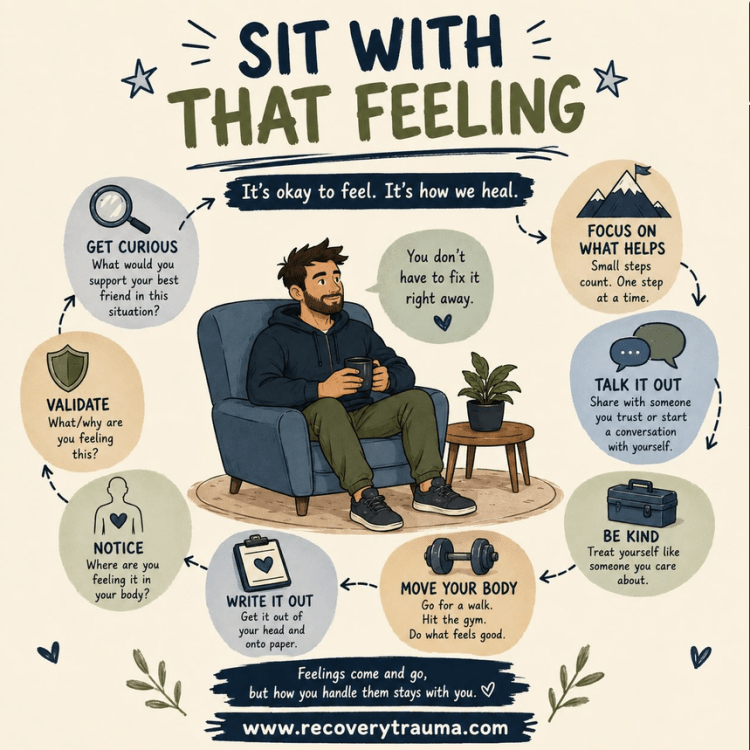
“Allowing emotions to flow” is another way to increase your well being. Healing begins with us acknowledging our feelings and allowing emotions to arise and flow through us. Ever fought against your own emotions? Does it work for you to suppress your strong emotions? Maybe for a short time, for a moment then eventually the same feeling comes back. This image encourages us to be curious and patient–its how we respond to our emotions/how we handle them that matters. Anger is often an indicator that something isn’t right and needs to be addressed. So explore the anger and let the emotion lead you the deeper issue. As you encounter the “core” issue, you recognize that your anger serves a purpose.
However, if the anger is suppressed, not dealt with then the issue remains unseen, unknown, and not resolved.