
Featured Image: Photo by Michael Cummins on Unsplash
The Great Ridge path above Castleton in Derbyshire, Peak District, England.

A.I generated image of ancient, weathered cross standing in field.
What’s forming your faith?
Because if we’re honest…a troubling amount of Christians are not being discipled by Jesus. They’re being discipled by whatever they refuse to question.
And if it keeps pulling us away from the way of Jesus…it’s not forming our faith.
It’s replacing it.”
Pastor Brandon “The Gospel According to Cable News”
What is forming your faith? Is it God’s Word diligently studied and interpreted properly for the purpose of following Christ? Do we allow others to influence our way of life without discernment?

Photo by Leo_Visions on Unsplash
Vita quae sola vita nominanda
Here’s a key question: what if God calls us to more than a sinner’s prayer or other religious, spiritual rites? He calls us to a way of life.
The phrase “vita quae sola vita nominanda” translates to “life which is to be called the only life.” This expression explains life that goes beyond mere existence or survival. Jesus is the Way of Life.
Key Concepts of Latin Phrase
- Genuine Life: your life being active, vigorous, and devoted to God.
- Spiritual Vitality: your life flowing with purpose and meaning, particularly in a spiritual context.
- Blessed Existence: your life is enriched with blessings and divine favor as you follow Christ.
Source:
https://duckduckgo.com/?q=vita+quae+sola+vita+nominanda&t=newext&atb=v531-3__&ia=web
I Am the Way, the Truth, and the Life
John 14:5-15 Berean Standard Bible: Emphasis mine
Context: Jesus is speaking with His disciples before His arrest during Last Passover. Jesus answers Thomas’ question.
The Way, the Truth, and the Life
5“Lord,” said Thomas, “we do not know where You are going, so how can we know the way?”
6Jesus answered, “I am the way and the truth and the life. No one comes to the Father except through Me. 7If you had known Me, you would know My Father as well. From now on you do know Him and have seen Him.”
8Philip said to Him, “Lord, show us the Father, and that will be enough for us.”
9Jesus replied, “Philip, I have been with you all this time, and still you do not know Me? Anyone who has seen Me has seen the Father. How can you say, ‘Show us the Father’? 10Do you not believe that I am in the Father and the Father is in Me? The words I say to you, I do not speak on My own. Instead, it is the Father dwelling in Me, performing His works. 11Believe Me that I am in the Father and the Father is in Me—or at least believe on account of the works themselves.
12Truly, truly, I tell you, whoever believes in Me will also do the works that I am doing. He will do even greater things than these, because I am going to the Father. 13And I will do whatever you ask in My name, so that the Father may be glorified in the Son. 14If you ask Me for anything in My name, I will do it.
This video explains the Greek terms in depth.
The way isn’t a belief system. It’s not a theological creed (statement of belief). The Way is a Person!

Photo by Francesco Gallarotti on Unsplash
Becoming Complete
Let’s compare 2 Parallel Gospel Accounts wherein each author uses a different term.
Video Link explains each term from the Greek, Latin, to English and why these differences matter immensely! Context: Jesus teaches His Sermon on the Mount
Matthew 5:48
48Be perfect, therefore, as your heavenly Father is perfect.
Notice that Luke gives us more context on this sermon with a different term for completion.
Luke 6:36
36Be merciful, just as your Father is merciful.
Both authors teach Jesus’ command that we are to be like our Heavenly Father. Matthew uses the Greek term teleios.
“Cognate: 5046 téleios (an adjective, derived from 5056 /télos, “consummated goal”) – mature (consummated) from going through the necessary stages to reach the end–goal, i.e. developed into a consummating completion by fulfilling the necessary process (spiritual journey). See 5056 (telos).
[This root (tel-) means “reaching the end (aim).” It is well-illustrated with the old pirate’s telescope, unfolding (extending out) one stage at a time to function at full-strength (capacity effectiveness).]”
Source: https://biblehub.com/greek/5046.htm
Luke uses a term translated as mercy or merciful compassion
Cognate: 3629 oiktírmōn (an adjective, derived from 3627 /oikteírō, “express visceral-compassions”) – compassionate, experiencing deep pity (lamentation) as God has for people who look to Him for help in their difficult situations. See 3628 (oiktirmos).
Source: https://biblehub.com/greek/3629.htm
Paul uses a similar term in Romans 1, 2 Corinthians 1:3, Philippians 2:1, and Colossians 3:12
3628 /oiktirmós (“visceral compassions”) is used of the deep feelings God has for all of us, and powerfully shows and shares in those following Him.
Source: https://biblehub.com/greek/3628.htm
Video explanation with in depth explanation.
Summary
Jesus calls us to become like Him and our Heavenly Father! He isn’t calling us to moral perfection as these verses have been misunderstood. The call is to walk with Him through grace in which He transforms us into new creatures in His image. As we mature, we become more like Him. Becoming like Him means that we are people in His likeness: a people of grace, compassion, and vigorous spiritual life that blesses others.
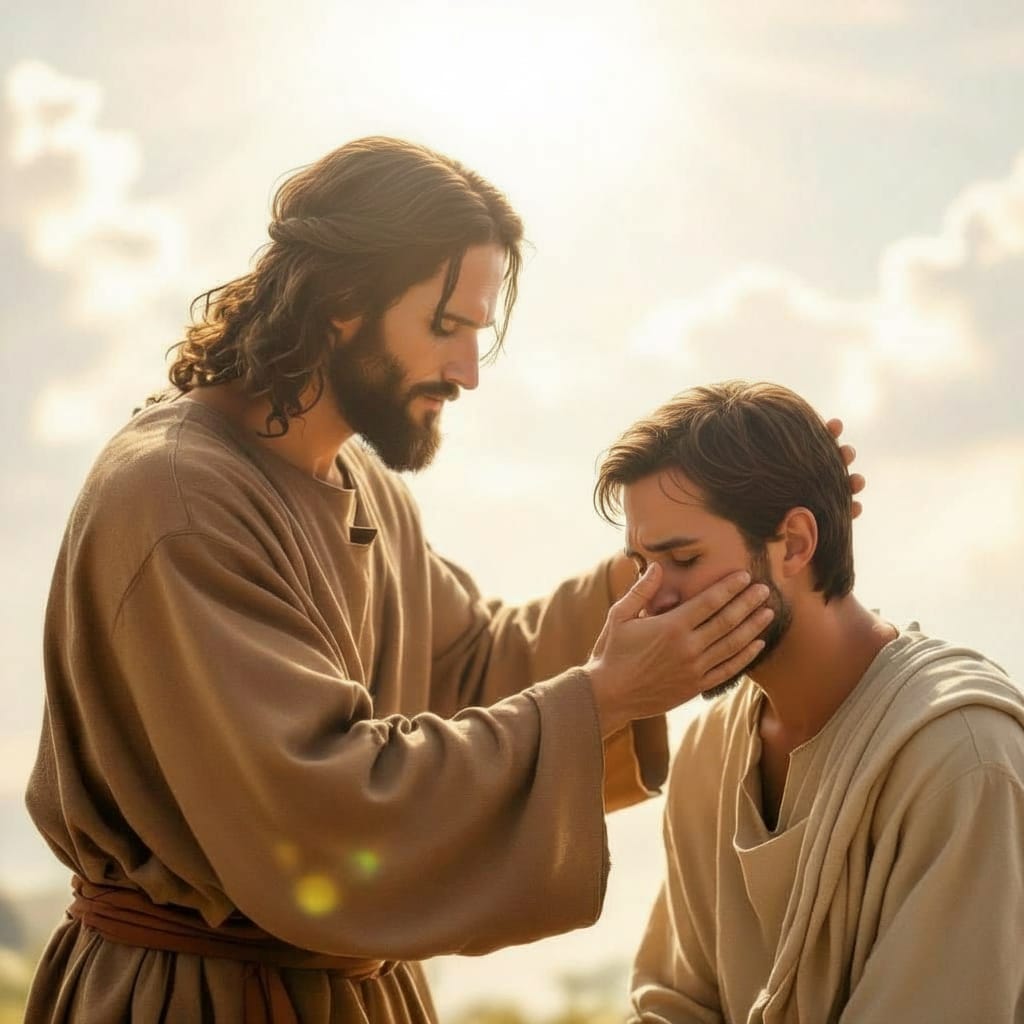
A.I generated image of Jesus’ healing touch. It’s His touch and presence that sustains and restores us!


All to Jesus I surrender should never be sung by a church congregation unless they really mean it. And in my experience only a few really do. He doesn’t want visitation rights for Sunday and Wednesday He wants all of us
LikeLike